Upgrading a radio used to be simple. Swap the unit, connect a harness, and you were done. Today, that approach no longer works on most modern vehicles. Whether you’re installing a digital cluster, infotainment system, airbag module, or camera system, VIN programming is often required.
But why has it become mandatory — and what exactly does it do?
What Is VIN Programming?
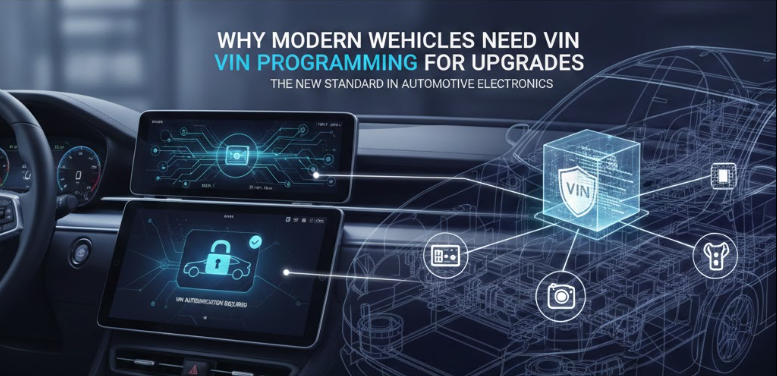
VIN programming is the process of matching a vehicle component (like a radio or control module) to a specific vehicle using its Vehicle Identification Number (VIN).
Modern modules are not “generic.” They are designed to:
Communicate with the vehicle’s network
Verify compatibility
Activate specific features
Prevent theft or misuse
When a module doesn’t match the VIN, it may not function properly — or at all.
Why Automakers Require VIN Matching
1. Anti-Theft Protection
Infotainment systems, clusters, and ECUs are expensive. VIN-locking prevents stolen modules from being easily reused in other vehicles.
If the VIN doesn’t match:
The radio may display a security message
Sound may be disabled
Features may not activate
2. Feature Activation by Trim Level
Modern vehicles are built on shared platforms. A base trim and a fully loaded trim may use similar hardware, but software determines which features are active.
VIN programming tells the module:
Whether navigation is enabled
If heated seats are supported
If surround cameras are installed
What audio system is present
Without VIN matching, features can remain locked.
3. Secure Gateway Systems
Many newer vehicles (especially RAM, Jeep, GM, and Ford) use secure gateway modules. These block unauthorized programming attempts.
VIN authorization ensures:
Only compatible modules communicate
Aftermarket or incorrect parts don’t interfere with safety systems
Vehicle networks remain secure
4. Network Compatibility (CAN & Ethernet)
Modern vehicles use complex communication networks. Modules must:
Sync with other ECUs
Share data with the digital cluster
Integrate with ADAS systems
Communicate with the body control module
VIN programming configures the module to speak the correct “language” for that vehicle.
What Happens Without VIN Programming?
Installing a module without proper programming can result in:
No audio
Backup camera failure
Steering wheel controls not working
Warning lights
Feature loss
Error codes
Even if the hardware fits physically, software compatibility determines whether it works.
Why This Matters for Infotainment & Digital Cluster Upgrades
For upgrades like:
Uconnect 5 radios
Digital instrument clusters
OEM navigation systems
ADAS modules
Airbag control modules
VIN programming ensures the part behaves exactly as if it were factory-installed.
This is why many plug-and-play upgrade kits now include pre-programmed modules matched to your VIN — eliminating dealership headaches and compatibility issues.
The Shift to Software-Defined Vehicles
As automakers move toward centralized computing and software-defined platforms, VIN-based activation is becoming standard.
Vehicles are no longer just hardware machines — they are rolling computer networks. And just like a smartphone, hardware only works properly when authorized by software.
Final Thoughts
VIN programming isn’t an inconvenience — it’s the new standard in automotive electronics. It protects vehicles, enables feature control, and ensures safe integration across complex electronic systems.
If you’re planning an upgrade in a modern vehicle, understanding VIN programming isn’t optional — it’s essential.