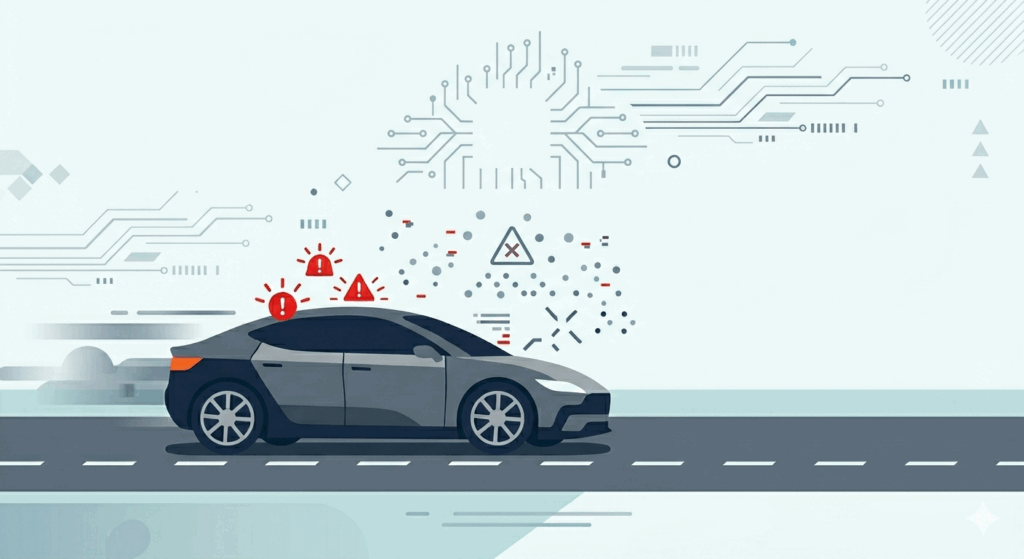
Modern vehicles are more advanced than ever, packed with digital displays, connected systems, and software-driven features. While this technology improves convenience and functionality, it also introduces a new kind of problem that wasn’t as common in older vehicles — software bugs.
Unlike mechanical failures, software issues are often unpredictable, harder to diagnose, and can affect multiple systems at once. The true cost of these bugs goes far beyond simple inconvenience.
What Software Bugs Look Like in Vehicles
Software bugs in vehicles don’t always appear as obvious errors. Instead, they often show up as inconsistent or unusual behavior.
A touchscreen may freeze or reboot. Audio may cut out randomly. Features may disappear temporarily. In some cases, systems may work perfectly one moment and fail the next without any clear reason.
Because these issues are not tied to physical damage, they can be difficult to identify and replicate.
Why Software Issues Are Increasing
As vehicles become more complex, the amount of software required to run them has grown significantly. Modern vehicles rely on millions of lines of code to manage infotainment, safety systems, communication networks, and powertrain functions.
With more software comes a higher chance of bugs. Even small errors in code can affect system performance, especially when multiple modules depend on each other to function properly.
Frequent updates and new feature rollouts can also introduce new issues, even while fixing existing ones.
The Real Cost Beyond Repairs
The impact of software bugs is not always financial, but it can still be significant. Time spent diagnosing issues, scheduling service visits, and dealing with inconsistent system behavior can be frustrating for vehicle owners.
In some cases, owners may replace parts unnecessarily, assuming a hardware failure when the issue is actually software-related. This leads to additional costs without solving the root problem.
There is also the cost of reliability. When systems behave unpredictably, it reduces confidence in the vehicle, even if the issue is minor.
Multi-System Impact of a Single Bug
One of the biggest challenges with software bugs is that they can affect multiple systems at once. Because modules are interconnected, a single issue can create problems across different features.
For example, a communication error between modules could affect infotainment, audio, and vehicle settings simultaneously. This makes troubleshooting more complex compared to traditional mechanical systems, where problems are usually isolated.
Over-the-Air Updates: Solution and Risk
Over-the-air updates have become a key part of modern vehicles. They allow manufacturers to fix bugs, improve performance, and add new features without requiring a dealership visit.
However, updates also introduce risk. A poorly implemented update can create new issues or temporarily disable features. While updates are essential, they must be carefully managed to avoid unintended consequences.
The Challenge for Diagnostics
Diagnosing software issues requires a different approach than traditional repairs. Instead of inspecting physical components, technicians must analyze system logs, communication errors, and software behavior.
This requires specialized tools and knowledge. In some cases, even dealerships may need to escalate issues to manufacturer support teams, especially when bugs are not widely documented.
The Shift in Vehicle Reliability
In the past, reliability was mostly defined by mechanical durability. Today, it increasingly depends on software stability.
A vehicle may be mechanically sound but still feel unreliable if software systems frequently glitch or behave inconsistently. This shift is changing how both manufacturers and consumers evaluate vehicle quality.
Final Thoughts
Software bugs are an unavoidable part of modern vehicle technology, but their impact is often underestimated. While they may not always result in physical damage, they can affect usability, reliability, and overall ownership experience.
As vehicles continue to evolve into software-driven platforms, managing and minimizing these issues will be critical. The future of automotive reliability will depend just as much on software performance as it does on hardware durability.